Linux System & Runtime Power Management
Let's dive deep into the power management framework inside the linux kernel
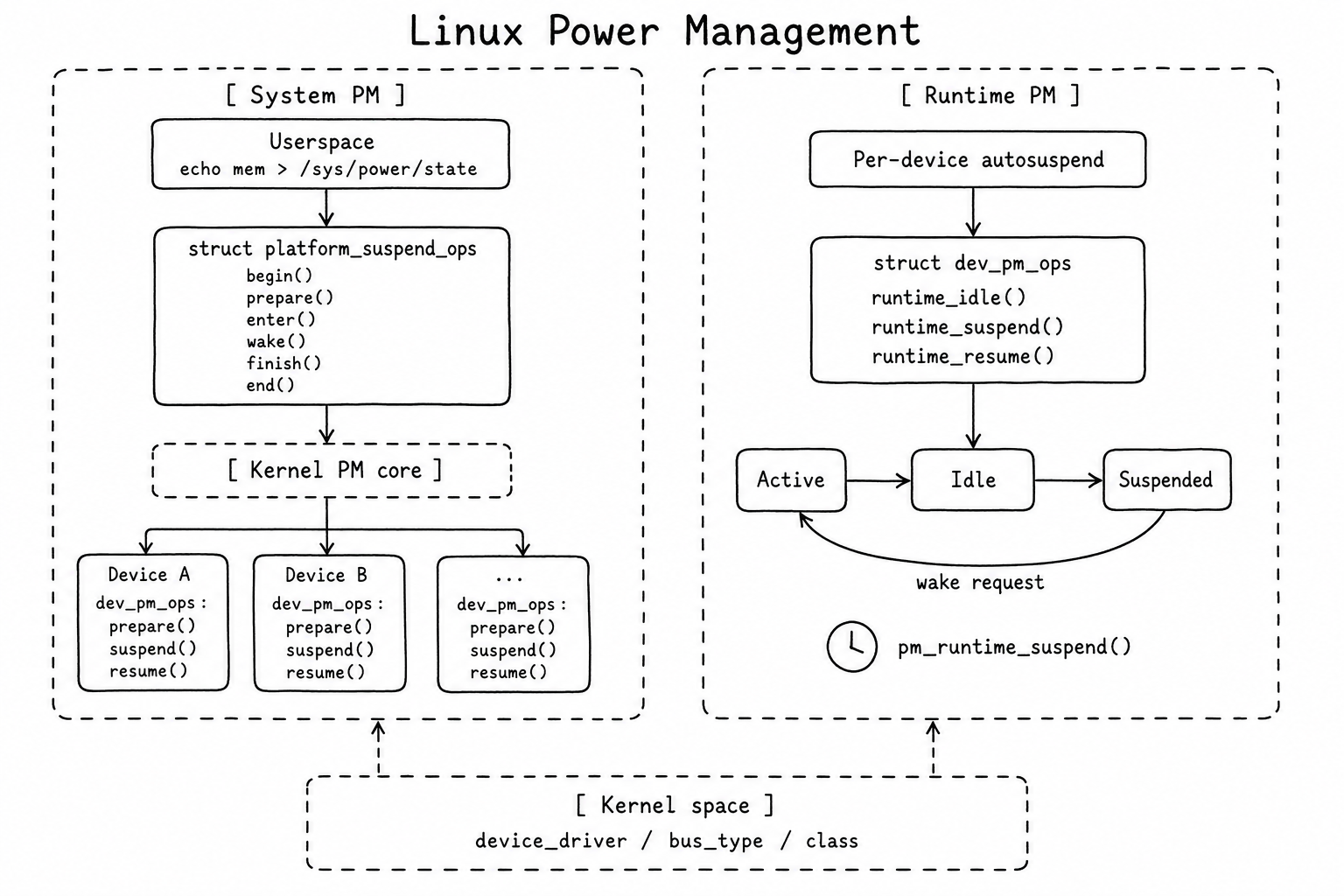
There are two techniques in power management (that will called as dynamic power management): Active and Idle. Active is where the device keep running but the power save is active that automatically adjust the system (e.g: CPU Frequences, Regulator). Idle is where …
Power Management in Linux is a big subsystem that includes so many subdomains: supported hardware, CPUIdle, CPUFreq governors, DVFS, thermal, and so on. In this blog, we are going to discuss the System Wide and the Runtime Power Management frameworks, how device drivers should handle
1. The key concept struct dev_pm_ops
The structure is a key part of device-driver and power management. That’s embedded into exist struct device_driver, struct bus_type, …
1
2
3
4
5
6
7
8
9
10
11
struct dev_pm_ops {
    int (*prepare)(struct device *dev);
    void (*complete)(struct device *dev);
    int (*suspend)(struct device *dev);
    int (*resume)(struct device *dev);
    int (*freeze)(struct device *dev);
    // ...
    int (*runtime_suspend)(struct device *dev);
    int (*runtime_resume)(struct device *dev);
    int (*runtime_idle)(struct device *dev);
};
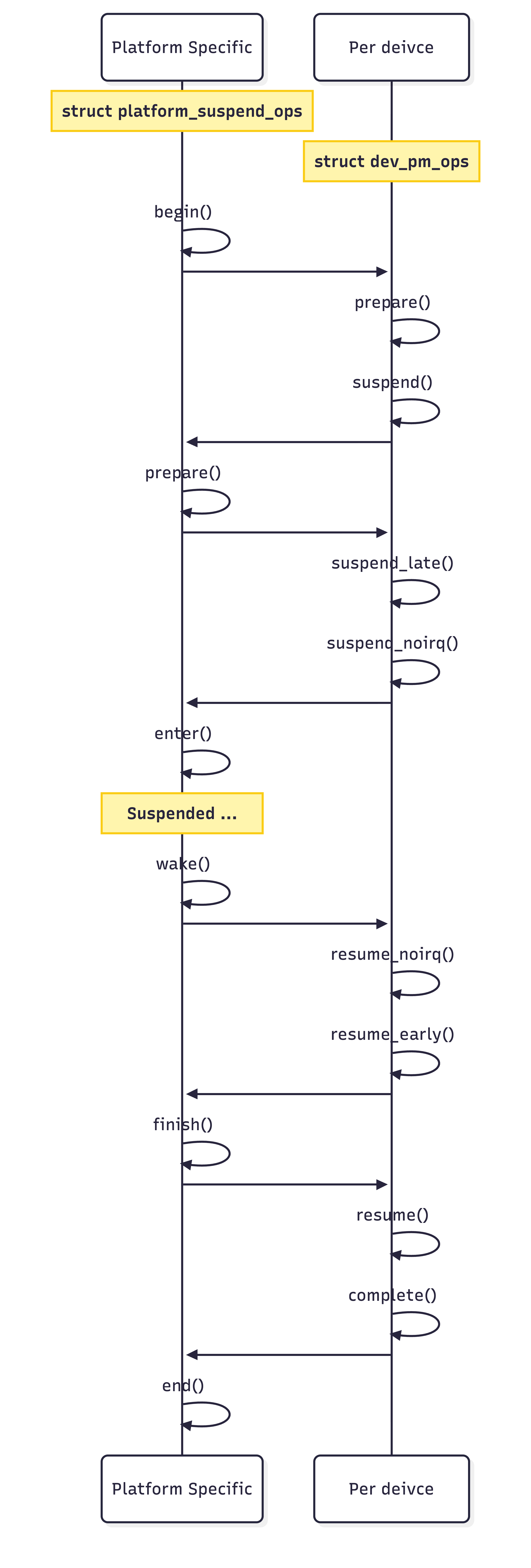
What happen when you do a system-wide suspend echo mem > /sys/power/state. Several hooks (platform suspend options) for platform specific will be called first and then trigger the callbacks (pm options) for every single driver in the platform.
sequenceDiagram
    participant PL as Platform Specific
    participant DEV as Per deivce
    Note over PL: struct platform_suspend_ops
    Note over DEV: struct dev_pm_ops
    PL->>PL: begin()
    PL->>DEV:
    DEV->>DEV: prepare()
    DEV->>DEV: suspend()
    DEV->>PL:
    PL->>PL: prepare()
    PL->>DEV:
    DEV->>DEV: suspend_late()
    DEV->>DEV: suspend_noirq()
    DEV->>PL:
    PL->>PL: enter()
    Note over PL: Suspended ...
    PL->>PL: wake()s
    PL->>DEV:
    DEV->>DEV: resume_noirq()
    DEV->>DEV: resume_early()
    DEV->>PL:
    PL->>PL: finish()
    PL->>DEV:
    DEV->>DEV: resume()
    DEV->>DEV: complete()
    DEV->>PL:
    PL->>PL: end()
You don’t have to implement all those callbacks for your driver, some of those are handled by the core automatically. But this just allows you to hook into important points.
The struct dev_pm_ops will be used for all the rest of the platform device driver level suspend.